
Who Would Even Find Your Website Online? The Truth About Running An Online Handmade Business.
I love to talk about the benefits of having your own website for your creative handmade business, or any business for that matter, what to include and what not to, different hosting platforms, etc etc and I’ll happily gabble on about this on my YouTube channel. Recently someone asked “who’s going to ‘find’ your website?” this, I think, is a common fear! What’s the point in having a website when I’m already on Instagram showing my work! Why should I invest time and money into a website if no one's going to find me!
I get it - sometimes it can feel like one more thing you’re told you need to have but is it really going to make a difference - what IF no one finds my website!
I want to answer this head on as yes you could feel that you’re covered if you just show up on Instagram or Tiktok - you have followers, they know you’re there. But here’s the thing:
1 - Are they buying from you or booking your services straight off of Instagram?
2 - When you're shopping online do you still check out someone's website even if you love what you see on Instagram, just to double check they’re genuine?
That gap - between following you and trusting you enough to buy, is exactly what a website does and instagram never quite can.
Why is the question of being seen and found so anxiety inducing?
As a creative putting your work out there, something that you've poured your heart and soul into can be nerve wracking. You’re exposing yourself and your work to the opinions of others! There is a sense of security of just posting on Instagram - it can feel less intimidating and maybe a little less serious, you perhaps have comments from regular followers, from friends and family who know you and your work. And it’s easy to stay in this safe space. Of course the opposite could be true and actually you hate having to show up on social media (I’m putting my hand up at this point!) and would much rather share your work on a website where you don’t have to be constantly posting or updating. It’s you, your work, and largely a silent audience!
However if you’re worrying about how anyone is going ‘find’ your website this does mean that you’re thinking about this from a business perspective - you’re thinking like a business owner - you want to be seen to sell your work - this isn’t frivolous posting into the void. Deep down you want to show and share your work with intention, and your website is the ultimate showing up online with intention!
How does someone find your website?
So let’s work through how we answer this question - what happens when someone is looking for something -
Route A: We ask friends, family or colleagues for recommendations - they give us a recommendation and then we go and check them out for ourselves
Route B: We ask google and we search.
Google is really like a match making service.
Someone asks a question or searches for something and then google (or any other search engine for that matter) then comes back with a list of sites and links for what it thinks will be most useful for you and will answer your question. As website and business owners this means that we need to be answering the questions that our ideal customers are asking and looking for. That way Google is going to see us as being a useful source and show them a page that’s going to closely answer their search. It’s a bit like a spaniel that just wants to please!
For example if someone is looking for wedding gift for a couple - they want to give something that the couple will love but also is thoughtfully chosen. They know their friends love holidaying in Cornwall and also that they’re the ultimate hosts and love holding dinner parties and having friends over. So they’re really looking for something like a hand crafted serving platter with a cornish theme - and this is what they put into the google search.
I put myself in the shoes of the wedding gift buyer and I did this exact search just to see what was there and this is what came up:
1- Google AI overview
2 - Etsy - vintage pottery
3 - Osbourne Pottery - osbournepottery.co.uk - Cornish Black Platter product
4 - Rick steins online shop
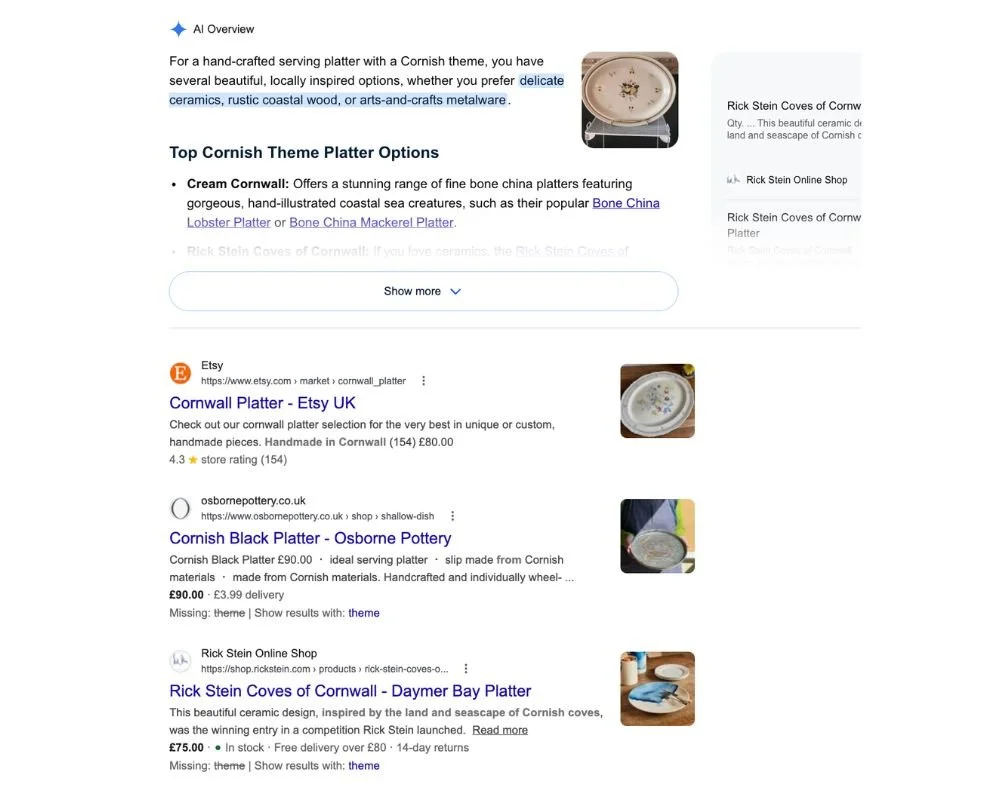
Big high fives to Osbourne Pottery - it definitely caught my eye that this was an independent pottery and not Etsy where I’d have to scroll through lots of listings, I’d probably check out Rick Stein too but it doesn't necessarily fill that “unique’ gift I’d had in mind.
This little moment is worth pausing on, I can see you looking at Etsy in second place on those search results and asking “do I need to be on Etsy to get found, or can my own website do the job?” Here, Osbourne Pottery’s own website beat Etsy to the click — not because Etsy is bad, but because a focused, independent site can read as more trustworthy and more ‘exactly what I’m after’ than a sea of similar listings.
This is what else I did!
I naturally clicked on Osbourne Pottery - checked out the home page - yes it looks exactly the type of thing I’m looking for, but I wanted to double check so I headed to their instagram page to see what they posted there. It matched the feel of the website and it showed more of what they’re up to, their inspirations, and behind the scenes. So that ticked another box - they’re current and it’s exactly the type of gift I know the couple would love. Back to the website I went and started selecting the perfect gift….. Now if I was genuinely looking for a wedding gift I'd probably have ordered something there and then - probably the £90 duck egg large platter (I love collecting jugs so I probably would have also bought myself a £25 small seaweed jug on a whim whilst I was there!!).
So how did Google recognise that Osbourne Pottery would be a good fit for what I was looking for. Well it’s several factors:
Firstly the product descriptions and keywords that are being used in the product. The product title is “Cornish Black Platter” so straight away google knows that this is Cornish and it’s a platter, two of the things I was looking for. There’s other copy in the description that Google recognises as being useful for so it shows me this listing.
(At the end of this article is a link to a free guide on putting your product listing together)
Now there will be other factors that google looks for such as how useful the site is to me - it’s a functioning store so it’s going to be useful, there’s useful information about the studio and the descriptions are in depth, so Google recognises that this is a good quality site and provides useful content.
Google also looks for page experience and usability from the point of view of the visitor, such as site responsiveness (for example how it’s viewed on a mobile or tablet) as well as the accessibility and performance of the site, what is the site structure like, can google crawl the site and does it have proper headings.
Essentially Google wants to show you a good quality website that's going to meet your needs.
Now you may have noticed that the top line response to my initial search was from Google AI and this is becoming so important as a lot of people will just look here when searching for something - whether you’re a fan of AI or not this is what you’re seeing first. So to have people find your website you not only need to be optimised for search engines (SEO) but also for AI generative engines (GEO).
Before you run a mile and think well now I have another thing to think of - really what’s the point! This is actually a good thing.
GEO looks at content a little differently - it’s even more wanting to be the pleasing spaniel…. spaniel on speed!
Generative engines - such as AI tools like Claude, Gemini (Google AI), Chat GPT, are looking for content that is helpful, well written and people first. So having a blog on your website is great for this, for answering specific questions your audience may have. Making sure you have good quality images. Writing genuine content that’s in your voice and with your specific point of view. Being different and having a different perspective on things is good here - the GEO will return answers and sites that are going to be the most useful but also that are going to offer unique perspectives.
So I believe this is a great opportunity to be seen and for people to find your website. You can be yourself - talk about your expertise in your craft, your inspiration, your passions, why you do what you do, a particular technique you do. Be informative and avoid the generic.
There’s no special formula to having your website found online. As well as the best practices for a website that I mentioned above and good SEO - titles that inform your audience as to what the piece is, or what the service is that you offer, informative descriptions of your pieces. Make use of alt tags for images to genuinely describe the image, and write honestly about your work.
There’s no shortcuts when it comes to getting your website found online - it takes time and effort, and as a business owner deep down you already know this to be true.
That said, this isn't a reason to put it off. How long this takes varies, but the work compounds: a well-optimised product page or blog post you write today is still quietly doing its job for you in a year's time. The foundations you lay now are what Google and AI search tools will be reading and ranking long after you've moved on to the next piece.
As small business owners and creatives it’s very easy to think we’ll figure it out ourselves as we’ve done so many times before. But trusting in the knowledge of others such as getting someone else to design and build your website or using a template so you can get started and then take it from there can really lighten the load and relieve the headaches and obstacles we put in place ourselves.
People are already searching for exactly what you do, in exactly the way you do it. They do exist. Your job is to help them find you and have a website that tells Google, ChatGPT and other search engines that you’re exactly who they’re looking for.
And that's really the heart of it: the people who want exactly what you make are out there searching right now. The only question left is whether your website is ready to be found by them.
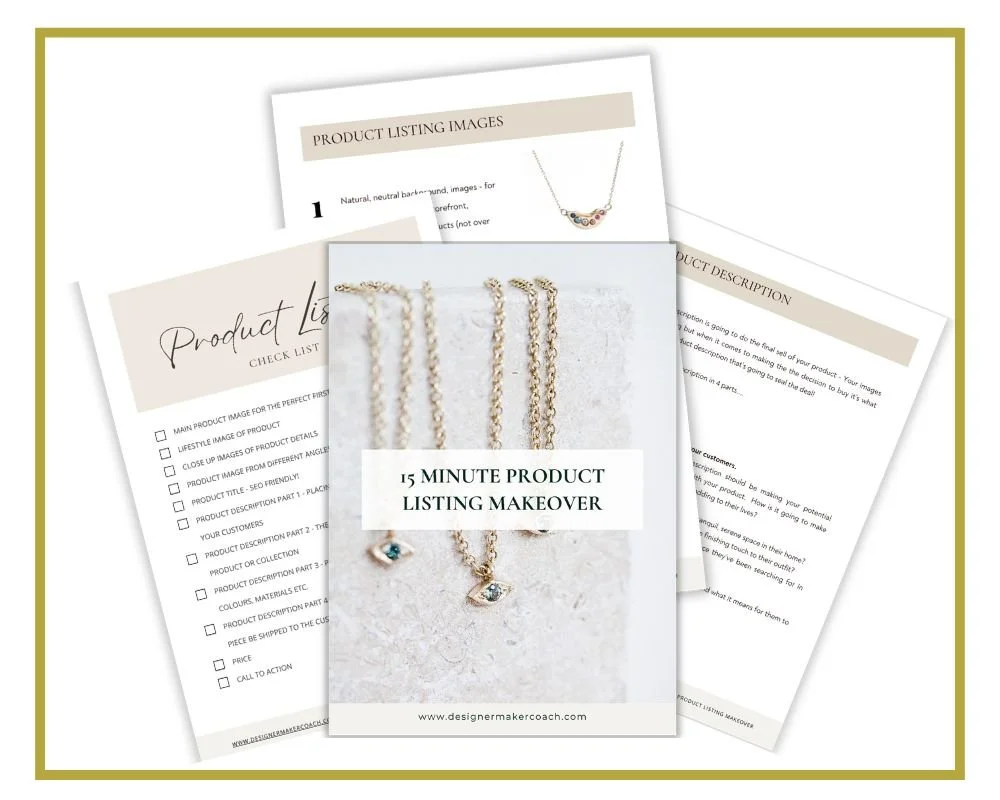
If you want to refresh your product descriptions and give them a quick 15 minute makeover you can download the free guide below.
FAQ’s answered in this article:
Can people actually find my handmade business website on Google?
Do I need to be on Etsy to get found online, or can I use my own website?
What words should I put on my website so customers can find me?
Is social media enough, or do I need a website for my handmade business?
How do I write product descriptions that show up in search results?
How long does SEO take to work for a small handmade business?